Victoria F. Gaitán: Beauty in Decay
Over coffee, the six-foot, tattooed photographer behind Sweet Meat talks puberty, pollution and pornographic corn syrup. Her art, it turns out, is just honest.

She enters Starbucks—the platonic form of an ideal of rebellion long disenfranchised by irony and corporate cynicism. Standing before me, she is blonde, no less than six feet tall, with tattoos graffitied across her body.

Victoria F. Gaitán is dressed to kill (or at least menace). She is in all black with leopard-spotted platform pumps that were adorned with little blood red bows, and a menacing Rob-Zombie-meets-Wyatt-Motherfucking-Earp cowboy hat with an image of a Jolly Roger skull. And if she told me she was a pirate, I would have believed her right then and there and signed my life away to hunt for treasure. Alas, I’m in khakis and a blue button-down shirt like the douche that I am, and so I will not be burning any Caribbean ports on this day, yarr.
If this all sounds completely intimidating, well… I would never admit to being intimidated, per se, but I can tell you that I didn’t exactly feel great. None of this, of course, was Gaitán’s fault—she is, without a doubt, one of the sweetest persons you could meet. In fact, one could be forgiven for initially calling her demure. Although, it becomes apparent to me rather quickly, that she also is polite, engaging, funny, and wickedly bright.
Originally hailing from Adelaide, Australia, Gaitán studied photography at the University of South Australia, although she initially wanted to study film. She tells me that her instructors at the university were taken aback by her desire to actually learn and practice the craft she aspired to master. She tells me that she admires the visions of filmmakers like David Lynch, Jim Jarmusch and Tim Burton, and how the universes they construct in their films have an arbitrariness and apartness—a consistent set of rules and a detachment from our world that she finds particularly appealing. “They are bound by their own systems, values, senses of logic and propulsion,” she tells me.
Gaitán clearly addresses these kinds of contradictions with her photography—she assaults the breach between beauty and decay; she cleaves whimsy from darkness, and demands consideration of gluttony until the point of expulsion. She consistently describes her work as being, on some level, fucked up—a term she uses to discuss her photography which both explore and embrace the maddening and confounding issues of today’s cultural reality.
So in turn, we talk about things that are fucked up. We talk about things like girls going through puberty as early as age eight because of pollution. We examined the horror of sexual abuse and the new phenomenon of sensationalized instances of pedophilia that made parents hyper-aware of how they treated their children. We lamented on how violence was an institutionalized construct of social masculinity, and how sometimes, in a disturbing twist of emotional reflex, the most terrifying thing about suicide was wondering who had to clean up the mess.
These things are fucked up. Victoria’s pictures are not—and this is not a criticism. How can one regard the world as it is, a place where the majority of women, men and people are perpetually subjugated by their circumstances, biology and fate, born in a time and a place where just being alive can, for all intents and purposes, be a birth defect?
How can one know this and not signal to the world a sense of inexorable dread and terror?
How can one be aware and fail to dredge up the mire beneath that which corporate culture deigns to afford popular dignity?
Her art is not fucked up. It is honest.
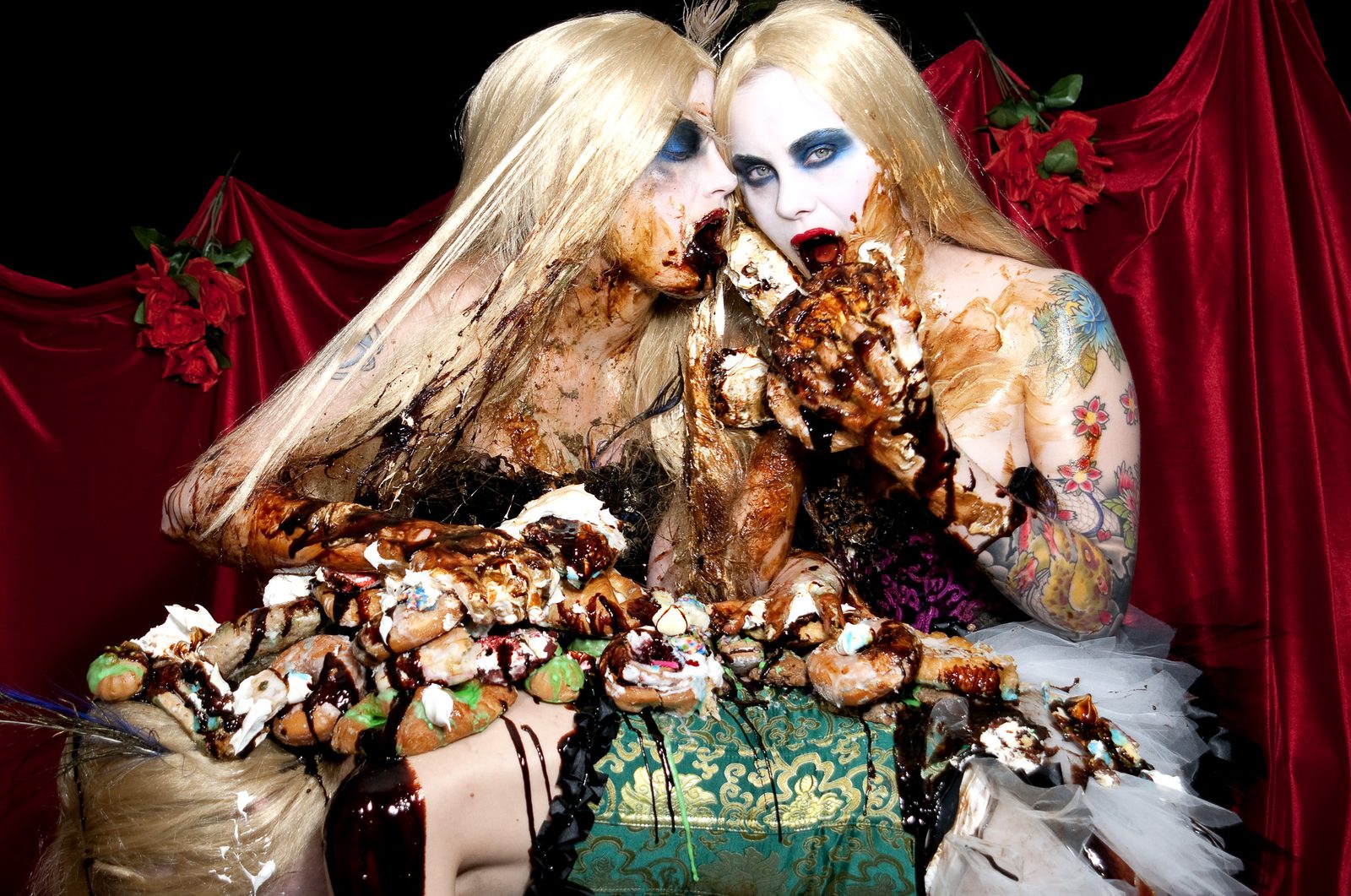
My analytical side wants to analyze these compositions; the indecisive side of me can’t decide as to whether this is a good idea or not, despite the fact that I cannot avoid analyzing it regardless. I am indecisive as to whether or not to explore and express this analysis or not—could my vacillation be in and of itself, a product of her genius? My first instinct is to say the photos are too on the nose, but they aren’t. In a composition, something must be on the nose in order for viewers to pursue the loose ends inside their own psyches in order to synthesize an experience from the art, or, perhaps a newfound understanding that can be incorporated into the gestalt of one’s understanding of life.
Enough German psychobabble: An artist gets to have it both ways, to claim the personal motivation and intention within the work, as well as the subjective interpretation that people ascribe to it. This is secretly why non-artists hate artists, because they get to have their cake and eat it too; incidentally, most artists have to go through a lengthy period of starvation before actual cake can even come close to being part of the equation. Gaitán offers to me the cakes in her Sweet Meat series that represent both the sweetness which society expects of women, and the impermanence of the physical beauty that society primarily values in women: Given time, the cakes will rot and become worthless, just as a woman’s looks will fade.
I grant her this—it is, after all, her cake. And yet, I am struck by the appeal of the cakes; surrounded by so much delicious cake, who could resist only a bite? To me, I see a society that force-feeds its women this bounty of sugary cake until, as in the photos, she has no choice but to vomit this artificial essence of sweetness, this viscous and disgusting corn syrup. With this in mind, it is a profoundly disturbing coincidence that pornographic magazines use corn syrup to depict semen on women’s faces.
Her work, in her own words, concerns access and restriction, decadence and decay, and I am struck by the symbols of innocence, the flowers and the cherries, juxtaposed with this regurgitating river of popular culture, this force-feeding of girls, from childhood on, using mass-marketed diabetes of the soul.
The photographs of Gaitán are striking, and offer a dichotomy of beauty and disfigurement that is somehow more beautiful by summation and resonant in many ways. It is no surprise that Gaitán, the woman, the person, presents a similar dichotomy: She is a great beauty by any estimation who is marred by darkness and tattoos and yet somehow is more beautiful and more compelling for it all.
In talking to Gaitán, I can say with utter confidence that in her case, at the very least, society is hopelessly shortsighted. This is because her photos present another dilemma—that the value of a composition extends beyond its aesthetic beauty alone. In fact, the superficial “prettiness” or the aesthetic “quality” of a composition can even detract from the deontological “goodness” of the piece itself. In this fashion, Gaitán guides her audience to an intrinsic truth: In the measuring of human worth, our eyes may be the most worthless judges of all.
From the MO print archive: this story first ran in The Premiere Issue of Meets Obsession Magazine.
- Words: Justin Brill
- Artwork by Victoria F. Gaitán
Keep it loud