RIP: The Death of the Album
How singles are killing the album, and one writer's plea to save them, with help from Nirvana, the Smashing Pumpkins and former RIP editor Lonn Friend.
The first CD that I ever bought was Nirvana’s Nevermind at a recycled record store. I was in the ninth grade when I bought the album with the money I had saved up from my allowance. I opened it up immediately at home and examined the cover art, song lyrics, and production notes before I played the album. I liked the way the CD felt in my fingers. It was mine and I had forever to enjoy it.
By the end of the week, I had absorbed the entire album, and understood the angst of Kurt Cobain. We were mental soul mates; and even today, I can still sing the lyrics verbatim to “Smells Like Teen Spirit.”
Today, I, like millions of other music fans, no longer have to spend our Saturdays at the record store waiting in line to buy an album. With the advent of digital media fueled by Internet music purveyors such as Napster, Amazon and iTunes, we could stream music onto our laptops and listen to entire songs or albums instantaneously.
Boom, we have become the “now generation” with instant gratification with the click of a mouse.
“We live in a very fast information, disposable, here-today-gone-later-this-minute culture,” said Lonn Friend, noted music journalist and former editor of RIP magazine that was responsible for bringing artists like Metallica, Guns N’ Roses, Pearl Jam, and Nirvana to commercial recognition, in an interview with Meets Obsession. Friend likened the current environment of fickle music listeners to a “tweet culture.”
I did not disagree with his statement. Over the years, perhaps due to my impatience or “fickle” interest, I stopped listening mostly to albums and moved on to singles contained on my handy iPod. And it occurred to me, while playing Lykke Li’s single, “Little Bit” on the metro one Friday afternoon, that I never cared to buy her album, and had no idea who she was as an artist.
I couldn’t help but wonder then, that if I had stopped listening to albums, did the world stop, too, and if they did, would that mean that albums were becoming extinct?
I caught my breath and found my Nirvana record when I got home. While touching the cheap plastic cover, I thought, no, it couldn’t be.
What happened? Certainly, music didn’t change. Perhaps we did.
If we were to examine the history of recorded music, it goes without saying that with each successive generation and technological advance, audiences have altered how they have enjoyed music. At one point, record players were the primary medium for people to listen to albums, where friends would convene around an old turntable and float away into the musical reverie.
Then came cassette tapes and CD players that allowed us to search for our favorite tracks, and fueled a “cruise and choose generation.”
Today, we’re able to convert CDs into digital media files that can be swapped and shared, and as a result, we have instant access to any track we want to listen to within seconds. With the explosion of digital media into mainstream culture, album sales consequently, have declined in the music industry. According to a February 2010 article by CNNMoney.com, the Recording Industry Association of America had reported that album sales have dipped by an average of 8 percent in the last ten years.
Meanwhile, individual tracks sold digitally continue to experience exponential growth. Billboard charts director Geoff Mayfield, in a 2008 interview with USA Today, said of the changing tides, “[T]he business has changed. In the ’70s, albums drove the market... With the advent of digital music, we went in the opposite direction. Not only are people buying individual songs again, but there’s a much broader spectrum of songs available.”
Friend agreed and added, “Now we’re in an age where music is discovered by a great majority of people, online. You [can] search websites to find the lyrics or music attached...It’s not an experience where the entire record is listened to.”
Moreover, the Internet, which artists used to advertise their music, has altered the way albums are promoted in the industry. Fans can visit an artist’s Myspace, Facebook or YouTube page and hear the latest track without ever having to purchase an album.
With its fierce competition and slimming profit margins, the commercialization of music has forced artists to compete for public attention by reducing their song tracks to ringtones or television sound bites. No longer can artists simply rely on their albums to engage fans, but rather, they need “catchy jingles” to build a fan base.
Drummer Tommy Lee of the legendary rock band, Mötley Crüe echoed these sentiments when he discussed the difficulty for an artist to produce and sell a successful album in today’s market. In a June 2011 interview with Noisecreep, a subsidiary of AOL Music, Lee stated that albums were “a waste of time,” and that he would never make another one again, citing that audiences cared more about singles than what they heard on the radio.
“Well, knowing Tommy Lee for almost 25 years... He’s just seeing how the times have altered and how there’s no marketplace for what they used to do,” said Friend, defending the validity of Lee’s response. “When I was on tour with them during the ‘Dr. Feelgood’ years, that record sold over 5 million copies before anybody turned their heads. Those numbers are gone. The market can’t sustain that kind of musical production anymore.”
With the speed of technology and short attention span of listeners, music artists only have a few seconds to grab public attention. Perhaps that is why controversial artists like Lady Gaga can summon legions of fans with her over-the-top persona to fuel her album sales.
“[She’s] the greatest music marketer of our time,” said Friend. “She understands the image. She understands star [power]. She’s a genius at doing that.”
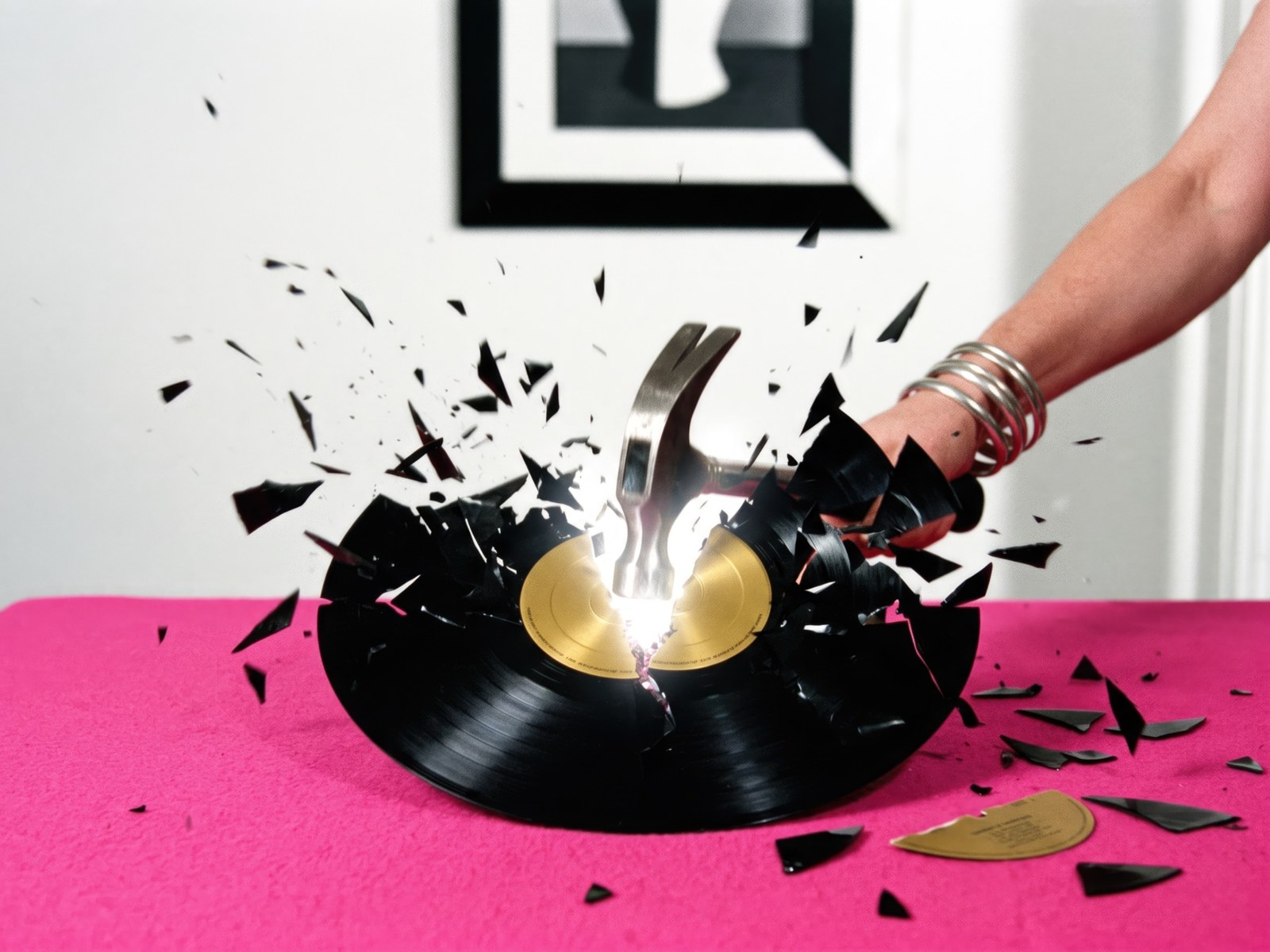
However, while album sales have declined, a new niche market, the sale of vinyl records, is making a steady comeback. According to a 2010 report by the Nielsen Company and Billboard’s 2010 Music Industry Report, vinyl record sales were up by 14 percent from 2009.
In an interview with talk show personality Stephen Colbert, music icon Jack White of the rock band, White Stripes discussed his reasoning for producing vinyl records. “I like the idea of having it in your hands. You can’t hold an MP3, right? This is about putting an object and dropping the needle and sitting down and looking at this cover,” White said. “That’s the romance of music that we’re losing in this generation, I think.”
“You can’t hold an MP3, right?”
Perhaps due to their ability to evoke nostalgia, several artists, like White have marketed and sold vinyl records successfully.
However, because of their high up-front costs, typically only well-established bands can afford to produce them. “I would say, if you have the resources, the room, the time... I would get a turntable and... get some of those records on vinyl,” Friend said. “It really is a singular… experience. There is a warmth about the grooves, the pops, the imperfection.”
Friend’s words left me remembering the first band I ever saw in concert: the Smashing Pumpkins. I was in high school when I first heard the band’s album, Mellon Collie and the Infinite Sadness and parked in line overnight in front of the concert hall to buy their tickets. When I saw Billy Corgan on stage, he was a dream and I allowed myself to slip into the reverie of his wailing voice as he sang “1979.”
I can’t imagine albums being extinct. What would Mellon Collie or Radiohead’s Pablo Honey, or Biggie’s Ready to Die be to fans if they were never composed?
They spoke to us, a generation who, at one point, bought those albums, flipped through the booklets, and read the lyrics to hold on to a tangible piece of an artist.
There was a warmth that we experienced when unwrapping those records. Perhaps it was the warmth of the artist’s soul that we felt emerging from those tiny discs.
And this is why the album, in all its sacred glory, must not die.
From the MO print archive: this story first ran in The Premiere Issue of Meets Obsession Magazine. It was written in the iPod and MySpace era, just as the vinyl revival was getting started; the sales figures and industry talk are as they stood then. We're running it as it first appeared.
- Words: Yohana Desta
Keep it loud